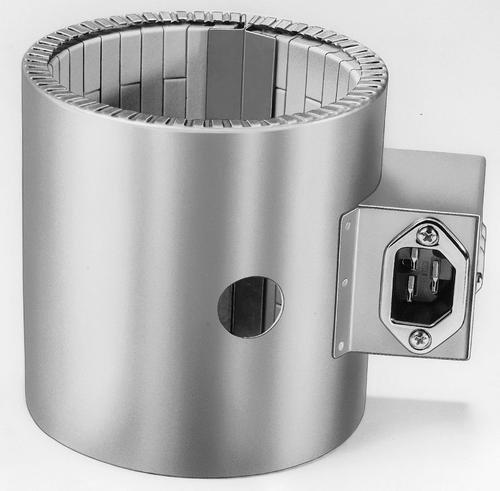

A ceramic electric heater is a heater with uniform heat distribution. The thermally conductive metal alloy ensures uniform surface temperature, eliminating hot and cold spots on the equipment. It has advantages such as long life, good thermal insulation, strong mechanical properties, corrosion resistance, and anti-magnetic field.
One type is made by threading alloy wire through small ceramic blocks and encasing them in a stainless steel shell. It is widely used in plastic machinery and chemical fiber machinery.
Another type is made by casting alloy wire into a semiconductor using quartz glass as the raw material. It has the characteristics of high temperature resistance (up to 1200°C), corrosion resistance, beautiful appearance, and wear resistance. It is widely used in high-temperature heating furnaces, semiconductor engineering, glass, ceramics, and wire engineering.
Ceramic electric heater comes in coil and plate shapes, with reliable operation, long life, robustness, energy saving, flexible installation, high temperature resistance, fast heat transfer, good insulation, and no restrictions on model or size. According to user requirements, the wiring method and voltage can be from 36V, 110V, 180V, 220V, 380V, with a maximum power load of 6.5W per square centimeter. Compared with traditional electric heaters, energy consumption can be reduced by 30%.
Previous: Technical parameters of SMN-2 Siemens drawer switch cabinet contact pressure detector
Next: Buying a clamp-on ground resistance tester, no need to worry about how to operate