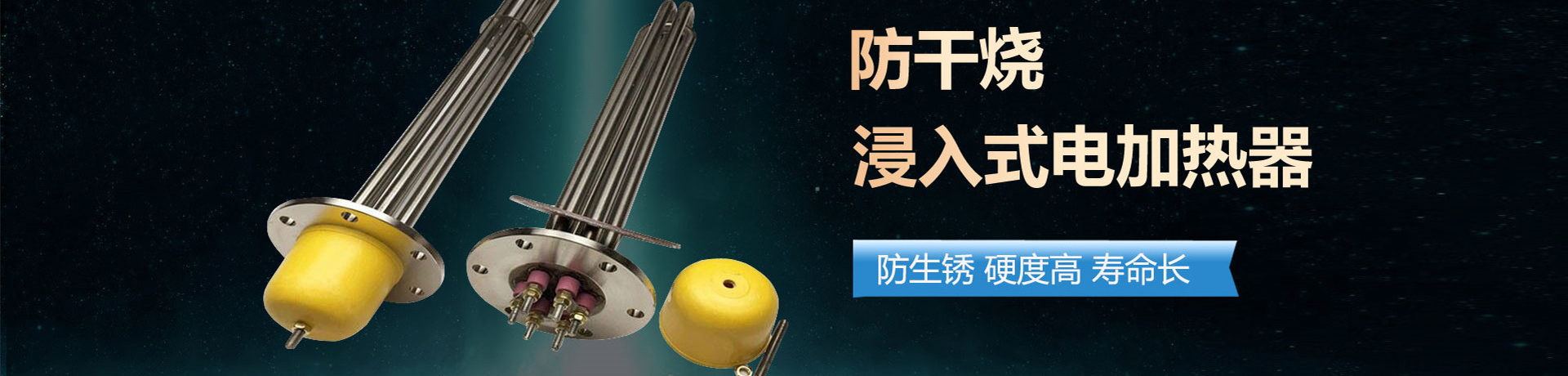
Heating Rod
Manufacturing of four-way single-head and double-head electric heating tubes:
Diameter (metric) [mm]: 3; 4; 5; 6; 6.5; 8.0; 10; 12; 12.5; 14; 16; 18; 20
(Non-standard can be customized)
Diameter (imperial) ["]: 1/8; 1/4; 3/8; 1/2; 5/8; 3/4 (Non-standard can be customized)
Sheath material: A. Stainless steel 304 B. Stainless steel 310S C. NCF800
Maximum sheath temperature of heating element: 750℃
Resistance material: NiCr8020
High voltage stability (high temperature) rated voltage ≤24V -500V-DC>24V 1500V-AC
Insulation resistance (500 [V-DC] unheated): ≥50MΩ
Maximum leakage current (253 [V-AC] unheated): ≤0.5mA
Length tolerance: ±1.5mm
Power tolerance (unheated): +5% -10%
Input voltage: 12V-440V (Non-standard can be customized)
Unheated length at terminal end: <3mm-20mm
Unheated length at non-terminal end: <3mm-20mm
Connection wires:
a. Fiberglass insulated nickel wire (temperature resistance 450°C-750°C)
b. Crimped Teflon wire (temperature resistance 250°C)
c. Crimped silicone insulated wire (temperature resistance 200°C)
d. Crimped fiberglass insulated nickel wire (temperature resistance 450°C)
Four-way hot runner heater specifications
Flat (mm): (1.3*2.3), (4.8*8.6), (2.4*4.2);
Square (mm): (3.0*3.0), (3.5*3.5)
(Non-standard can be customized)
Material: A. 304 stainless steel B. 310S stainless steel C. NCF800
Maximum sheath temperature of heating element: 750℃
Resistance material: NiCr8020
High voltage stability (high temperature) rated voltage ≤24V -500V-DC>24V 800V-AC
Insulation resistance (500 [V-DC] unheated): ≥50MΩ
Maximum leakage current (253 [V-A] unheated): ≤0.5mA
Length tolerance: ±2mm
Power tolerance (unheated): +5% -10%
Input voltage: 12V-440V (Non-standard can be customized)
Connection wire: Crimped Teflon wire (temperature resistance 250°C)
(Special can be made)

|
I. Basic structure of heating tube:
The heating tube uses stainless steel metal as the outer shell. Along the axial center of the tube, spiral electric heating alloy wire (NiCr8020) is uniformly distributed. The gaps are filled and compacted with magnesium oxide sand, which has good insulation and thermal conductivity. The tube end is sealed with liquid glue, silicone glue, or ceramic glue (moisture-proof design can be made for humid environments). The connection wires are made of pure nickel (copper) and high-temperature wear-resistant wires. This metal heating element can heat air, metal molds, and various liquids.
II. Special design of heating tube:
According to different usage conditions, safety, and installation requirements of the heating tube, the heating tube may also include sealing structure, 90-degree elbow outlet, attached flange fixing, crimped corrugated tube, crimped stainless steel mesh, tube end with threaded device, built-in thermocouple, fuse, and other structures.
III. Performance, application, and lifespan of heating tube:
The heating tube is made by placing a heating element inside a metal tube and tightly filling the gaps with crystalline magnesium oxide powder that has good heat resistance, thermal conductivity, and insulation, and then processed through other processes. The heating tube is a heating element specifically designed to convert electrical energy into thermal energy. It has a simple structure, high mechanical strength, high thermal efficiency, safety and reliability, and easy installation. It is widely used in plastic molds, packaging machinery, extruders, automation equipment, medical machinery, hot pressing molds, etc.
Under normal use conditions, the service life is over 10,000 hours.
IV. Resistance calculation of heating tube:
Example: 220V 1500W electric heating tube
P=1500 watts (power) U=220 volts (voltage) Find I (current)
I=P/U=1500/220≈6.82 amps
Ohm's law: Find R (resistance)
R=U/I=220/6.82≈32.27 ohms
V. Precautions for using heating tube:
1. The heating tube should be stored in a dry place.
2. When connecting the heating tube with a thermocouple, pay attention to distinguishing the positive and negative poles.
3. Pay attention to the voltage when using the power supply for the heating tube.
|